


1. Raw Material Preparation
Glass Substrates: Ultra-thin, high-purity glass sheets (suitable for mobile phone screen sizes) are prepared. These will serve as the base for the display layers.
Liquid Crystals: High-quality liquid crystal materials are synthesized to achieve the precise alignment required for mobile phone displays.
Polarizing Filters: Polarizing films are manufactured to enhance light modulation for optimal mobile screen visibility.
OCA Film: Optically Clear Adhesive (OCA) films are prepared for bonding display layers with minimal reflection and high optical clarity.
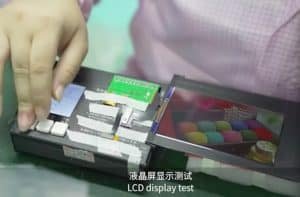
LCD DISPLAY TESE
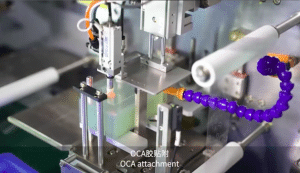
DCA ATTACHMENT
2. Thin-Film Transistor (TFT) Layer Fabrication
Thin Film Deposition: A glass substrate is coated with layers of semiconductor and conductive materials (e.g., indium tin oxide or amorphous silicon) using techniques like sputtering or chemical vapor deposition (CVD).
Photolithography: Patterns for pixel electrodes and circuits are created using photolithography, a process that involves applying a photoresist, UV exposure, and etching to form the intricate wiring needed for high pixel density on mobile displays.
TFT Formation: Thin-film transistors (TFTs) are integrated to control individual pixels, ensuring high resolution and fast response times essential for mobile screens.
3. Color Filter Production
Color Layers: Red, green, and blue (RGB) color filters are printed or deposited on a separate glass substrate to create vibrant, accurate colors.
Black Matrix Addition: A black matrix is applied to block stray light between pixels, enhancing contrast and visual sharpness.
Alignment Layer Application: A thin alignment layer is applied and rubbed in a specific direction to guide the orientation of liquid crystals.
4. OCA Film Attachment
OCA Placement: An OCA film is applied between the TFT substrate and the color filter substrate to bond them together. This adhesive layer ensures high transparency, durability, and reduced light scattering, which is critical for mobile phone displays.
Vacuum Lamination: The substrates are aligned and laminated in a vacuum environment to prevent air from being trapped between the layers.
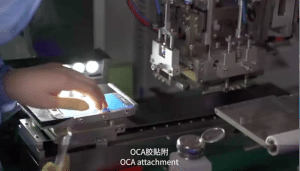
OCA ATTACHMENT
5. High-Pressure Air Bubble Removal
Pressure Chamber Process: The laminated assembly is placed in a high-pressure autoclave or vacuum laminator to remove any remaining air bubbles trapped during the OCA bonding process. This step ensures perfect adhesion and eliminates visual defects.
Bubble Inspection: Advanced inspection equipment checks for residual air bubbles to ensure flawless bonding.
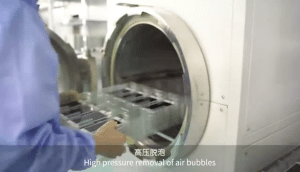
HIGH PRESSURE REMOVE AIR BUBBLES
6. LCD Cell Assembly
Spacer Distribution: Microscopic spacers are distributed across the glass to maintain uniform cell thickness for precise light control.
Sealing and Liquid Crystal Injection: The two glass layers are sealed along the edges, leaving a small opening. Liquid crystals are injected through this opening via capillary action, and the inlet is then sealed.
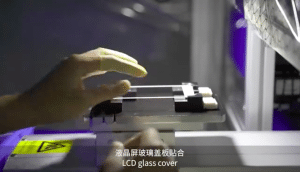
LCD GLASS COVER
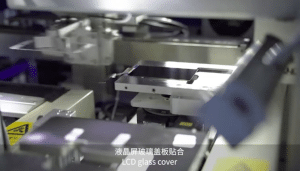
LCD GLASS COVER
7. Integration of Polarizers and Backlight
Polarizer Attachment: Polarizing films are applied to the front and back of the LCD for light modulation, enabling clear display visibility in various lighting conditions.
Backlight Assembly: A compact LED backlight unit is attached. It includes light guides and diffusers designed to provide uniform brightness, ensuring optimal readability for mobile phone screens.
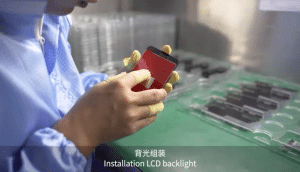
INSTALL LCD BACKLIGHT
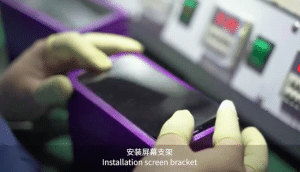
INSTALLATION SCREEN BRACKET
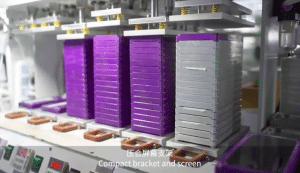
COMPACT BRACKET AND SCREEN
8. Testing and Calibration
Electrical Testing: The TFT circuits and pixel performance are tested to ensure precise pixel control.
Brightness and Color Calibration: The display is calibrated for brightness, contrast, and color accuracy, meeting the high standards required for mobile devices.
Bubble Inspection: Additional checks confirm that no air bubbles or adhesive irregularities remain after lamination.
9. Driver IC Integration and Final Assembly
Driver IC Installation: A driver integrated circuit (IC) is bonded to the display to control pixel signals, ensuring fast refresh rates and smooth graphics.
Touch Sensor Integration (if applicable): For touchscreen functionality, a thin touch sensor layer is added and laminated with another OCA layer.
Frame Assembly: The LCD module is enclosed in a protective frame and equipped with connectors for integration into mobile phones.
10. Quality Control
Defect Inspection: The display undergoes rigorous testing for defects such as dead pixels, uneven backlighting, or alignment issues. Mobile phone displays require extremely high defect-free standards due to their small size and high resolution.
Durability Testing: Tests for impact resistance, heat tolerance, and waterproofing are conducted to ensure the display meets durability requirements for smartphones.
11. Packaging and Shipment
Anti-Static Packaging: The finished LCD modules are carefully packaged in anti-static and shock-proof materials to prevent damage during transportation.